St. Louis geospatial industry is at an ‘inflection point.’ Will the jobs come?

ST. LOUIS — Business leaders have worked for years to attract and grow geospatial companies in the region. Now, industry leaders say, St. Louis is at an “inflection point.”
Over the past 10 years, donors have given millions of dollars to the industry here. Government and business officials have started eight initiatives and incubators to help grow geospatial companies. Eight companies have moved or opened offices in the region, seven others have expanded, and at least 50 have started anew.
Leaders across the industry now generally agree: The region has made strides in teamwork, public relations, education and workforce development. But the jobs haven’t yet followed.
“All of that stuff is great but it means nothing if we don’t have jobs to put them in,” said Mark Munsell, executive director of GeoSTL, a new nonprofit that aims to help geospatial companies grow, connect industry players and bolster the region’s workforce.
Geospatial technology is the collection, analysis and use of data associated with geography and location. It tracks produce as it leaves a farm and arrives at the grocery store. It helps insurance companies set coverage rates based on improved risk predictions. It helps build cities in animated films such as Zootopia.
St. Louis leaders have called the industry one of three pillars of the workforce of the future, along with agtech, which boosts efficiency and sustainability in agriculture, and fintech, which targets financial systems and services. And in a region where employment over the past 15 years has grown about half as much as it has across the country, leaders here hope geospatial jobs could someday stack up to the thousands employed by companies like the Boeing Co., BJC Healthcare or Washington University.
To that end, GeoSTL is now collecting job numbers from geospatial companies here; the number of jobs and firms has not been continuously tracked, officials say. The nonprofit aims to release a report on progress this summer.
Some experts think St. Louis is on its way.
Ronda Schrenk, CEO of the nonprofit United States Geospatial Intelligence Foundation, knows of St. Louis’ efforts, but said that the COVID-19 pandemic slowed down growth.
St. Louis, she said, probably isn’t where people thought it would be a decade ago.
“I saw the economic boom occurring in the St. Louis region in 2018, 2019,” she said.
“Then everything slowed down and it took a while to come out.”
Other national observers weren’t convinced St. Louis was making progress.
Wendy Nelson, executive director of the Chicago-based Geospatial Professional Network, said her association hasn’t seen any noticeable growth in St. Louis membership, and hasn’t been approached by area representatives in recent years.
“I thought Denver was already a centrally located geospatial hub with a concentration of federal agencies out there,” Nelson said.
Growth of an industry
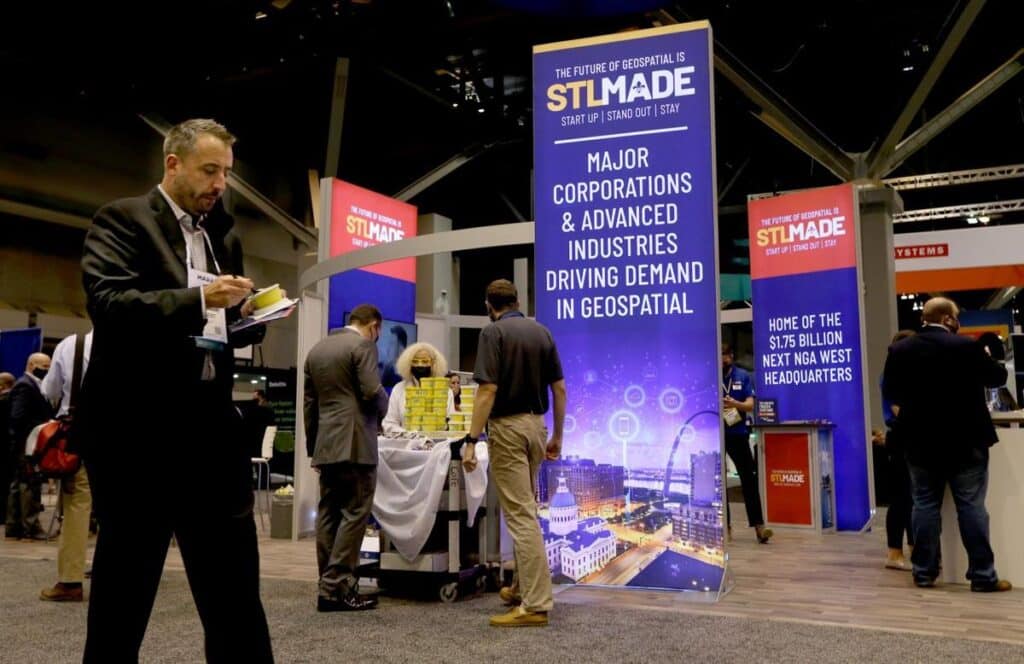
Ten years ago, the National Geospatial-Intelligence Agency, the U.S. government’s defense intelligence and combat support arm, announced that St. Louis had been selected as the home of its new $1.7 billion facility.
It kicked off a flurry of activity.


In 2020, regional planning initiative GeoFutures outlined a strategy to build a geospatial technologies cluster in St. Louis. It targeted talent development, technology innovation and an international reputation.
In 2021, startup incubator T-REX opened Moonshot Labs downtown, NGA’s first-ever unclassified coworking space for geospatial professionals.
And local universities got involved. In 2022, Harris-Stowe State University started its GEOINT summer intensive for students from Historically Black Colleges and Universities. This fall, Washington University will offer its Applied GeoAI Certificate.
Since 2015, eight geospatial firms have expanded in St. Louis, adding over 600 geospatial jobs in the region, according to GeoFutures’ latest report.
Since 2021, St. Louis has hosted three GEOINT Symposiums, the nation’s largest annual gathering of geospatial intelligence professionals.


Last September, the new NGA campus opened in north St. Louis, at the corner of Jefferson and Cass avenues. Workers are currently in the process of moving from their old offices near Soulard into the new facility.
In February, the regional business group Greater St. Louis Inc. launched GeoSTL, the nonprofit incubator, as local leaders increased efforts to draw in more companies and jobs.
Then, last month, the newly formed nonprofit Taylor Geospatial debuted, funded by Enterprise Holdings Chairman Andy Taylor, with a focus on the use of artificial intelligence in the industry.
Taylor said he is pleased to see the work done by local organizations to help build up the industry.
“Investment in the St. Louis geospatial ecosystem has always been about more than technology — it’s about what it makes possible for this region,” Taylor said in a statement provided to the Post-Dispatch. “By bringing together national security, research, talent, and innovation in one place, St. Louis is cementing itself as a world leader in geospatial innovation and creating opportunity at a scale that will last for generations.
“This isn’t just about attracting jobs or investment, it’s about shaping the future of our region and the people who call it home.”
Where are we now?
Esri, a major geographic information systems company based in California, has had workers in the St. Louis region since 1991. The company had 60 here in 2013, said Tara Mott, senior account manager for NGA, one of its biggest customers. Now Esri has about 100, in the Globe Building downtown.
Mott said that St. Louis’ biggest growth in geospatial over the past few years has been in higher education.
“Every school in the St. Louis region is producing people that we want to hire,” Mott said. “We probably still need to get more jobs. We could always use more jobs.”
Virginia-based General Dynamics Information Technology, known as GDIT, started a branch here 16 years ago. Will Clapperton, GDIT vice president of geospatial services and solutions, said the company had 20 workers in St. Louis a decade ago. Today, it has more than 200.
Clapperton said the community and government investments in making St. Louis a destination of choice for geospatial have enabled GDIT’s local growth. And Clapperton is optimistic about the industry’s continued expansion.
“This is an inflection point, sure, but I think, really, it’s like a catalyst to see the area continue to grow,” he said. “People are catching on that there are so many available resources.”


T-Kartor, a Swedish geospatial company that offers mapping and geographic information solutions, has had its U.S. headquarters in St. Louis since 2010. The company started with just three workers here and has grown to 44.
Simon Bailey, CEO of T-Kartor USA, said the last few years have been like “the awakening” as more people and industries are becoming aware of geospatial technology and its abilities.
But St. Louis still has a long way to go before it can call itself the global geospatial hub, said Brian Monheiser, head of growth at T-Kartor.
He said there is a lot of opportunity in markets other than national defense, like oil and gas, transportation logistics and precision agriculture, which can lead to real growth in St. Louis.
“There’s been all of these net positive gains in terms of activity and engagement, but I don’t know that they’ve necessarily led to new companies, new people or new jobs just yet,” Monheiser said. “I also don’t know that they’ve led to defined innovation just yet.”


At downtown entrepreneur development center T-REX, Walter Jenkins has been working on his new geospatial startup — one of several tech projects — for almost two years now. The venture, TransitChat, uses geospatial and artificial intelligence to streamline public transit operational workflows.
The agency doesn’t have clients yet, and Jenkins is still the only employee. But he says geospatial can be useful to transportation agencies for projects such as tracking ridership and on-time performance.
“I really believe in geospatial as just a way to conceptualize really complex data,” Jenkins said.
The future
Munsell, the GeoSTL chief, said the nonprofit is seeing multiple inquiries a day from geospatial companies. GeoSTL is looking for ways to build relationships and bring those companies to town to show them around the region.
But to make enticing offers, Munsell said, regional leaders need to come up with “a common playbook” on how to talk to prospective companies.
The region relies too much on “toasted raviolis,” he said, and other points of local cultural pride instead of economics.
“We need to show anecdotes of successful companies moving here,” he said. “I don’t think we’re still on the same page.”
Esri’s Mott said she hopes to see more development around the new NGA campus. Now that the NGA has delivered on its promise to build its new campus here, it’s time for St. Louis to keep its promise in creating a larger geospatial environment, she said.
“We are at a critical time,” Mott said. “NGA has just opened. … It is built, it is here. Has everyone stepped up? How will this community of geospatial rally to support?”


Jennifer Marcus, Taylor Geospatial’s vice president of strategic innovation programs, said she hopes that in the next few years, St. Louis can partner with big organizations such as satellite data providers and cloud providers.
“I think we’re at an inflection point,” Marcus said. “Let’s go scale this stuff and go big and do the hard work and move the needle.”
Elliott Kellner, president of Taylor Geospatial, thinks the region is rapidly approaching the point where it can call itself as a hub.
The last five years have been focused on building the foundation for a strong structure to stand on, Kellner said.