From Xerox machines to AI, WashU’s Carmon Colangelo mixes old and new technologies in his artwork

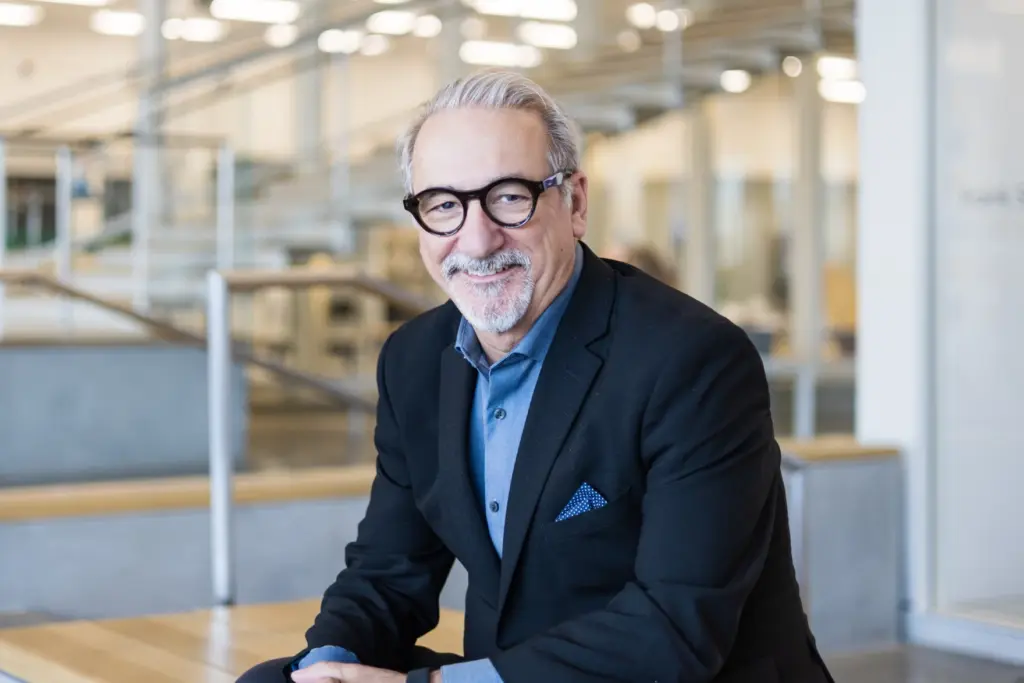
By Jeremy D. Goodwin | St. Louis Public Radio | April 28, 2026 at 5:00 a.m. CDT
To create his fine art prints, Carmon Colangelo combines centuries-old technologies with the latest digital tools. Colangelo draws from a palette that includes woodcuts, stone etchings and generative AI.
He started working with Xerox copy machines to transfer existing images into newly conceived prints. Colangelo became an early adopter of Photoshop in 1984 when his department at West Virginia University, where he taught at the time, purchased four Macintosh computers. A few years later, he was wowed by the ability to share artwork around the globe on the World Wide Web, likening it now to the mass production made possible by the invention of the printing press.
“The merging of the old and new constantly is what I think is so beautiful about art-making in general, and printmaking has a lot of that embedded in it,” Colangelo said.
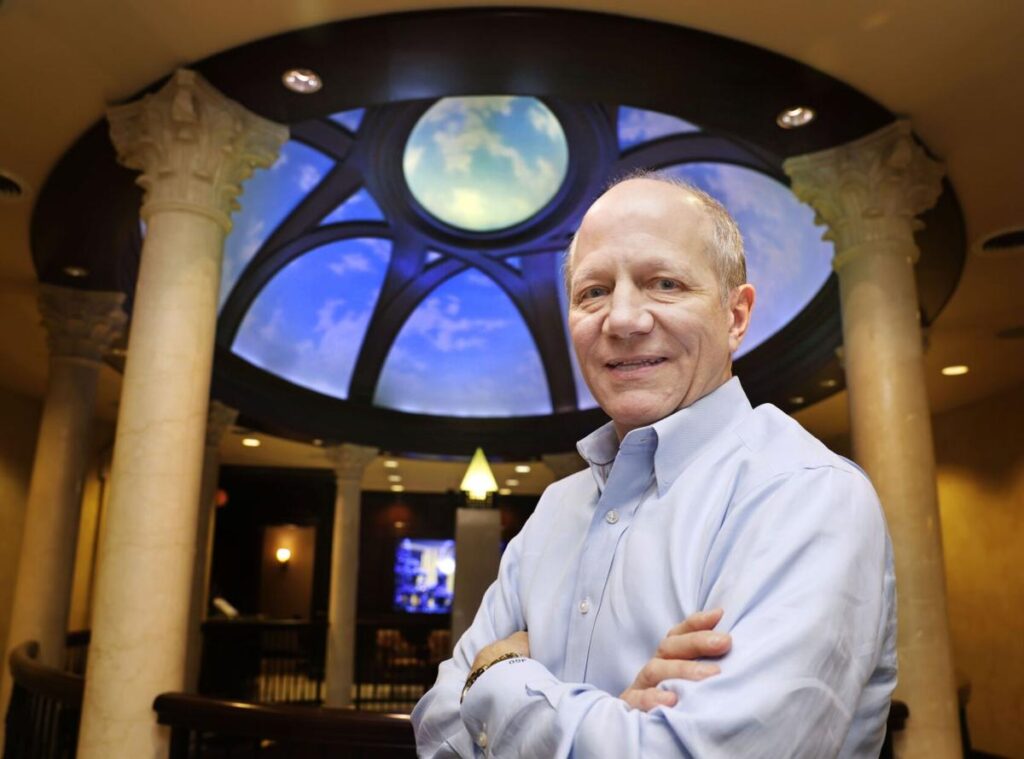
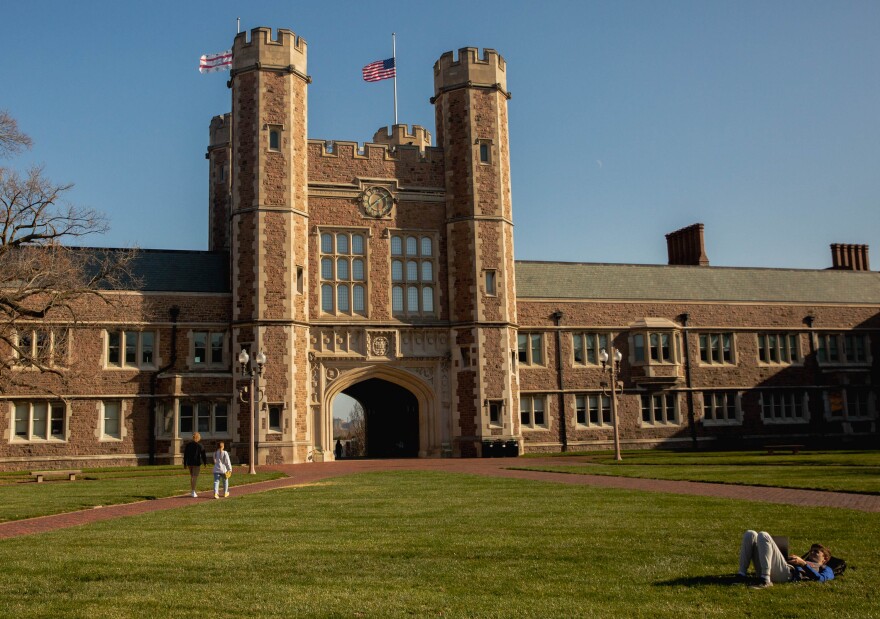
For the past 20 years, he’s made his innovative, abstract prints while serving as the founding dean of Washington University’s Sam Fox School of Design & Visual Arts. The school brought the university’s undergraduate and graduate schools of art and architecture together with the Mildred Lane Kemper Art Museum.
Colangelo, who was born in Toronto to two Italian immigrants, spent a year playing semipro soccer with the Polish team Polonia before dedicating himself to art-making and education. He’s retiring from Washington University at the end of April and plans to focus on his artwork and collaborations with his wife, Susan Colangelo, the founder and executive director of St. Louis Story Stitchers Artists Collective.
A survey show collecting work from the past 20 years of Colangelo’s output is on view at the Bruno David Gallery through June 26.
St. Louis Public Radio’s Jeremy Goodwin asked Colangelo how he stays in control of his artistic vision while introducing tools like AI to processes that trace back to Gutenberg and beyond.
This interview has been edited for length and clarity.

Jeremy D. Goodwin: You’ve said that your work is about discovery. What do you mean by that?
Carmon Colangelo: With, say, lithography, you actually put a mark, in my case, on Bavarian limestone. There already is something kind of magical about the surface of the stone. And then there’s a chemical process so the stone will accept ink. Then you have a mirror image of the thing, and you see the print come through the press, and it’s something you didn’t expect. And that discovery, that experimentation, that kind of unknown sense of what’s going to happen — that’s where innovation comes from.
Goodwin: How has evolving technology entered into your work as an artist?

Colangelo: The artists that I was really interested in as a student were that second generation of Abstract Expressionists, like Robert Rauschenberg and Jasper Johns, who worked with printmaking. I could see that they were transferring images from newspapers and everyday life. I thought that was more accessible, because I didn’t really understand abstraction at the time.
Printmaking lends itself to this. When Xerox machines became available, you could use them to transfer images. And when I was teaching at West Virginia University, the design faculty bought four Macintosh computers. And so all of a sudden, we were experimenting with computers.
Goodwin: Is there an important distinction to make between using a computer as a tool to execute the process you had in mind already, versus the technology itself becoming the medium and leading you to a different result than you would have had?

Colangelo: Right, the argument around the issue of whether it’s a tool or it’s something else is an interesting one. It’s sort of been a seminal part of my career.
The whole first half of my career, I was still making stone lithographs, drawing on stone – a very traditional process of the 19th century — and etching and woodcut. And those were all combined with digital.
I taught printmaking, so we also thought about the theory and thought about what its purpose was and how it was about the fine art medium. But it also sort of subverted the high art ideas in some ways, because as a printmaker, you’re marginalized a little bit. You’re outside the mainstream, slightly.
Goodwin: Have you seen students or early-career artists using technology in a way that you saw that and said, actually, the technology is becoming the boss? That the artist is not in full control of what’s happening?
Colangelo: That’s a great question – because, generally, no. Artists are somewhat skeptical about things and question them. I’m an adopter. I’m using AI now. As soon as language-based models were available, I would use them and mix it with hand-drawn models. It just seemed like an extension of all the other things that have come our way, from Xerox to computers to the internet. And in some ways, I jump ahead faster than my students.
Goodwin: But AI can act as the composer.
Colangelo: It can act as a number of things. It can be a generator, a composer, but the hybridity is natural to me.
In its early years, everything that was made in Photoshop looked like [it was made in] Photoshop. That’s what you didn’t want. So as artists you’re trying to have, for lack of a better word, a style or a way of working that’s present in the work that is your own voice.
Goodwin: So when you’re using generative AI to create artwork, it’s not a situation where you’re pressing a button and an image spits out to make a poster, instead of hiring an artist. You’re an artist who’s using it as one thing on the palette.
Colangelo: I’m questioning it from the very beginning. What does this mean? What does it do? What does it challenge? And I’m going ahead very skeptically.
The first images I got from Midjourney were just beautiful. Seductively beautiful. And I thought: That’s no good. Be careful.
Goodwin: Why was that a problem?
Colangelo: Because I could tell right away that it was going to look like everyone else’s image. It didn’t have any soul to it. It didn’t have a meaning. It didn’t have a reason to be in the world. It didn’t have anything to do with me, unless I did something with it that I’m familiar with in my own processes, which is usually to translate it into something else. Then you’re mediating the image.
I started making prints from discarded plates of architecture models. I give them another life. So in a way, the AI image is just like another material I use. It’s not the end in itself. It doesn’t feel complete or meaningful unless it’s translated into something.
Criticality becomes important. Curating becomes important. So you’re recontextualizing these things constantly.

Goodwin: As a viewer, you don’t need to be a critic or an expert to know how a piece of art makes you feel and how you’re responding to it, right? And the chances are that if you took that first, beautiful image from Midjourney AI and just put it on the wall, people are not going to have an emotional response to that because it wasn’t coming from a personal place. It didn’t have a personal meaning behind it.
Colangelo: I think you’re absolutely right. And people bring their own ideas to the work. In the things that I’m showing [at the Bruno David Gallery], some of them are very abstract and maybe very obtuse if you’re thinking you’re trying to find meaning. But if you’re trying to find joy or celebration or something different, you’re probably going to get that.
But with some images there’s legible, strange creatures in the work. And with those you’re like, “Whoa, what’s going on there? What is that? Where does it come from?” Some of the images of animals look like they could have originally come from John James Audubon and his diligent watercolors [before I transformed them].
Goodwin: Right now it’s a season of reflection for you. You’re stepping down from Washington University, and there’s a survey show drawing from the last 20 years of your artwork. What’s next?
Colangelo: I thought about stepping down as dean but continuing to teach. But that’s a job for a younger person to take. I do think it’s time for generational change. I feel like I’ve done good work to lay a foundation for the next generation.
My wife, Susan, and I feel like we’re in a position to build our own studio and to think about how we might support young artists. It won’t be in a nonprofit way, but hopefully we’ll find a way to make sure that we spend part of our life supporting young artists.
Have a question or comment about this story? Email St. Louis Public Radio.
Got a news tip? Send it to Jeremy D. Goodwin.