UnCommon Energy wants to solve power challenges for farms and rural America

by Eric Schmid | St. Louis Magazine | June 1, 2026 at 5:00 AM
Over the past few years, utilities across the country have won the right to steadily increase what they charge for power, and they’re likely to keep raising rates in the coming years too.
It’s a pinch for consumers everywhere, but especially for farm operators with equipment that draws large amounts of electricity. But that’s where Matt Ronken sees opportunity.
Ronken is the CEO of UnCommon Farms, a Brighton, Illinois-based business that offers a range of advisory services and resources for its farmer-member-owners, such as strategic planning, succession planning, and financial solutions.
The newest addition to that list is UnCommon Energy, a wholly owned subsidiary that looks to both develop renewable-based solutions for a farms’ electricity use and advise or manage large-scale energy or compute developments pitched on land owned by its members. Data center projects are bringing new urgency to that work, with farmers dealing with an increasingly stressed power grid or receiving offers to cash in by selling their land for a project.
“This is not transitory. This is the new reality,” says Ronken.
He sees challenges around energy use and generation as a disruptive threat to an industry with deeply rooted traditions. “There’s a pride: We’ve always done it this way. It’s always been successful. I’m not going to break the mold,” he says of the mindset some farmers hold. “The reality is that’s the frog in the pot of water where the heat is turning up.”
But that makes it a good time to catch farmers’ attention, says Jason Loyet, who leads UnCommon Energy’s business development, having spent two decades developing various power projects nationally.
“It’s like a perfect storm coming together,” he says. “Timing couldn’t be better to work with the farmers. They’ve got power challenges, power is getting more expensive. There’s a huge opportunity with land and power. Especially the rural power markets right now.”
The immediate opportunity for UnCommon Energy lies in devising ways to help lower what farms pay to power equipment that’s especially energy intensive, such as irrigation equipment, ventilation for hog barns, grain dryers, and others.
These pieces of equipment often come with their own individual meter and sometimes specific electricity rates, says Matthew Hansard, who leads sales and project development for UnCommon Energy.
The sheer number of individual meters can make it much more complicated to negotiate better electricity rates with utilities, Hansard says. “Who’s going to make the phone call on [hundreds] of meters?”
“When you only have one place to buy something, you just stop looking at the price, because you don’t have a choice,” he adds. “It should probably be an input cost that they’re considering.”
In other cases, Hansard says utilities will place restrictions on when a farm can draw large loads of electricity, particularly in the summer months when the grid is more stressed.
“Some clients aren’t allowed to dry grain in the summer even though it came out of the field because it was winter wheat,” he says. “So then it just sits all summer long. I’m sure the mice are like, ‘I love this policy.’”
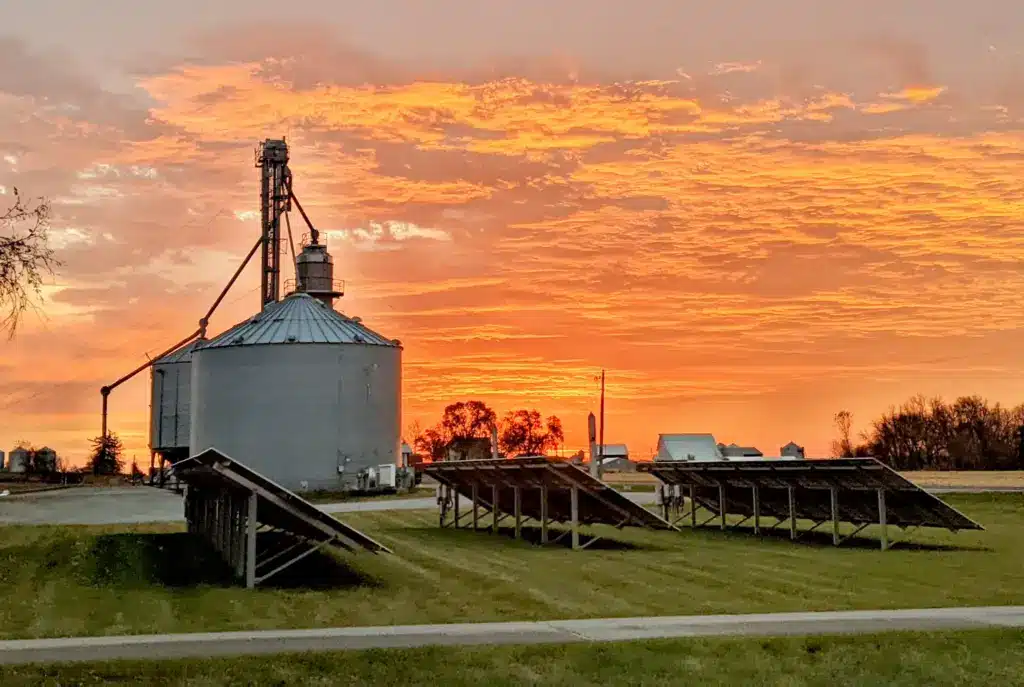
UnCommon Energy looks to solve this for individual farmers by developing and deploying solar installations on small portions of their property to offset a specific gobbler of electricity, such as a hog barn.
“This is one of the few purchases they can make that when it’s not in operation, it can still produce revenue for them,” he says. “That combine just sits there for months and doesn’t make any money.”
UnCommon Energy managing director Jack Scatizzi says it’s a capital expenditure that a growing number of farmers have been eager to make, especially as his team demonstrates how the investment cost can be recouped through energy savings, depreciation, and federal and state tax credits.
“We had never seen a group that was so eager to actually do the solution, even though the solution was costing them money,” he says.
It’s the landing spot for Scatizzi after having led the Missouri Technology Corporation for six years. Coming from the world of navigating early-stage businesses and venture capital, he says he’s “never seen this many green lights in a startup opportunity.”
UnCommon Energy has the operational backing and support of an established company with built-in clientele in the already roughly 120 farmer-members of UnCommon Farms. On top of that, Scatizzi says there are few if any renewable energy developers focused on farm projects that can boast a farmer-owned business backing them.
It’s a key differentiator when talking to potential clients, Scatizzi says: “They say, ‘Wait, you’re farmer-owned? Sure! Come on out. By the way, I told seven other solar guys to take a hike in the past six weeks.’”
The small scale installations, which Scatizzi says range between $150,000 to $600,000, are meant to keep the lights on as UnCommon Energy looks to get involved with much higher value projects around electricity generation or data center projects, which are increasingly headed to rural areas.
“Right now our clients are getting phone calls and they’re being offered ridiculous sums of money for their land, and maybe they understand why and maybe they don’t,” Hansard says. “But the backbone of energy, compute, and data is going to be built in Oklahoma, Kansas, Nebraska, North and South Dakota, Montana, and Wyoming.”
The values can be eye-popping. Aaron Mottern, head of UnCommon Energy’s operations, says some data center developers are valuing rural property around $350,000 an acre when the agricultural value of the land may be only $15,000 an acre.
“So if you have the right infrastructure, your land literally can be worth $30-, $40-, $100-, $200-million depending on the size of it, with nothing built on it yet,” he says.
Scatizzi says UnCommon Energy is agnostic on the outcome of these deals, but rather looks to ensure a farmer who’s been approached with a massive check has an outlet to understand what it all means and push for the best possible terms. He adds he’s seen offers where a developer wants exclusive rights to a piece of land without much of a concrete plan to actually build a facility.
“If the landowners are working with us, we will make sure everything is being done in order to make sure it’s done right,” he says.
UnCommon Farms feels responsible to help farmers have better representation when data center projects or just general electricity generation proposals inevitably come, Ronken adds.
“People are going to be approaching the farmers, and it’s a zero sum game in terms of the business deal,” he says. “Farmers have always been in the least powerful position in the chain, whether that’s being sold seed or inputs, or if that’s how and who you sell your grain to. They’re always squeezed.”
There’s opportunity beyond the data center buildout too. Even in its first few months of operating, Scatizzi says his team has already been approached by a landowner and rural electric co-op who are seeking a way to add electricity generation to support the needs of a large creamery nearby that’s undergoing expansion. Without new capacity, Scatizzi says it’s unlikely the co-op would have power to support the creamery’s growth.
“The problems are getting so big, that if you have a strong reputation and if you believe you can solve the problem, they’re welcoming you to the table,” he says. “If they can’t solve it, they’re gonna have a whole lot of angry people on their hands.”
These kinds of challenges are unfortunately common for farming and rural communities, says Hansard, as utilities aren’t that interested in spending potentially hundreds of thousands of dollars upgrading their transmission infrastructure for a customer who will net them only a few thousand dollars.
“Our clients find themselves regularly at the last stop on the line,” he says. “How do you have a grid that just dies there? How do we provide an energy backstop?”
Hansard adds there’s an imperative to build these energy solutions now, because it’s likely that the issues with electricity will only intensify in the years to come.
“Much like consolidation occurred around our members, this is going to occur around them,” he says. “And whether they would like to be a part of it or they would like to watch it happen, those are the two choices.”