
WashU physics team helps NASA probe the enduring mysteries of dark matter

by Sonal Churiwal | St. Louis Magazine | April 22, 2026 at 5:45 AM
Galaxies, including the one we call home, are within halos of dark matter. But what exactly dark matter is remains something of a mystery. A research team from Washington University is part of a NASA-led mission taking a step towards answering that question.
The Nancy Grace Roman Space Telescope—or Roman—is a multi-year project commissioned by NASA, with a goal of collecting a wide array of data to demystify dark matter. Physics professor Tansu Daylan’s research collective of over 12 post-doc, graduate students, and undergraduates is a central part of Roman. Though the team joined the project more than two years ago, the mission itself is over a decade old.
“As a PhD student, I used to think about the mission. Back then, it was called WFIRST,” Daylan says. “Over the last half decade or so, the mission has evolved into something much more mature.” Daylan is now part of that modern mission.
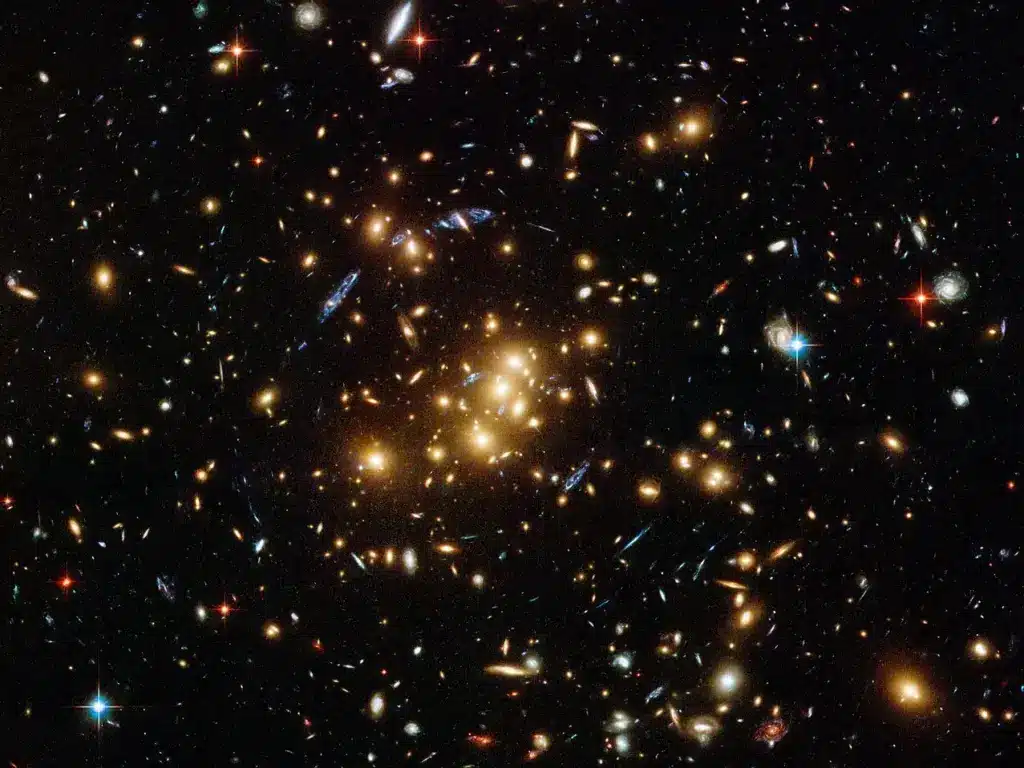
Over the last two decades, there have been a number of attempts to understand dark matter, but Roman has unique capabilities. Bryce Wedig, a fourth-year PhD candidate in physics working on the WashU team, explains, “Every once in a while, if we get lucky, two galaxies will line up.” This alignment creates a phenomenon called “gravitational lensing.”
“What you get is light being bent by the closer galaxy,” Wedig says. “Based on how the light is being bent, it turns out we can learn about the dark matter in that galaxy.”
Currently, these alignments are both rare and dim, making them difficult to detect. The Roman was designed to change that.
“Compared to the Hubble, [Roman] will be at least 100 times wider field of view,” says Daylan. Surveying larger patches of the sky translates into an ability to better detect gravitational lensing.
According to Wedig, researchers have identified about 1,000 gravitational lenses. But there are as many as 160,000 gravitational lenses that could help demystify dark matter. Roman will help survey wide swaths of gravitational lenses and then narrow down to 500 to focus on.
The Roman telescope is not building a new machine or technology to contribute to society, but it is “fundamental science,” as Daylan puts it. Because dark matter is distributed throughout the universe, demystifying it is central to understanding physical systems. According to Daylan, about 70 percent of the universe is dark energy, 25 percent is dark matter, and the remaining 5 percent includes planets, stars, and the matter around us. Understanding each of these pieces and putting them together is part of interpreting the “cosmic pie chart.”
“It is [about] understanding what makes up the physical system,” he says. “What makes us up? We mean to understand matter at a particle level. Understanding the particle nature of dark matter means to be able to reduce that matter into a set of particles.”
Last year, the Trump administration’s proposed funding cuts to NASA raised questions about Roman’s future. Wedig was part of a group on Capitol Hill advocating for continued research funding, with a special focus on Missouri’s elected representatives.
“At one point there were rumors of the Roman mission being outright cancelled, even though it was basically fully assembled,” says Wedig. “It would have been a tremendous waste, not only of money, but of the scientific potential.”
After overcoming scientific challenges and funding obstacles, Roman is set to launch this September. Once it reaches its orbit, Daylan’s team will help gather and synthesize data from the telescope, helping to make it publicly available.
“Of course there is the human space flight, which is in the news, but we interact with the so-called science mission directorate of NASA,” says Daylan, “which is the part that tries to expand our understanding of the university through machines like Roman.”